After the Aging Coal Fleet: Ramping Advanced Firm Power


During the confirmation hearing of Energy Secretary Chris Wright, Senator Jim Justice of West Virginia shared his opinion on the importance of energy:
“West Virginia truly knows energy. That’s all there is to it. And I would just tell you this, and I would promise you that this will be the case: energy is everything. Everything. If we think less than that we are thinking absolutely wrong. At the end of the day, every country in the world, the more energy they have, the healthier they are, the longer they live. Energy is every single everything.”
Senator Justice is correct - energy is everything. Our material world, the human world of buildings and highways, computers and factories, industry and agriculture, is all only possible because we harnessed large quantities of affordable and reliable energy. Senator Justice is also intimately familiar with the energy source that powered the industrial revolution and remains one of the largest sources of energy on earth – coal.
Unbeknownst to many, coal is far from dead. Global coal consumption reached an all-time high in 2025 of 8.85 billion metric tons, a little over one metric ton (~2,200 pounds) for every person on earth. About two thirds of that coal was used to generate electricity, with the remaining third mostly going towards industrial processes like the production of steel, cement, and aluminum. Globally, coal generated the most electricity of any source in 2025 - fueling one out of every three kWh produced. China is the largest consumer of coal for electricity production, followed by India and the United States.
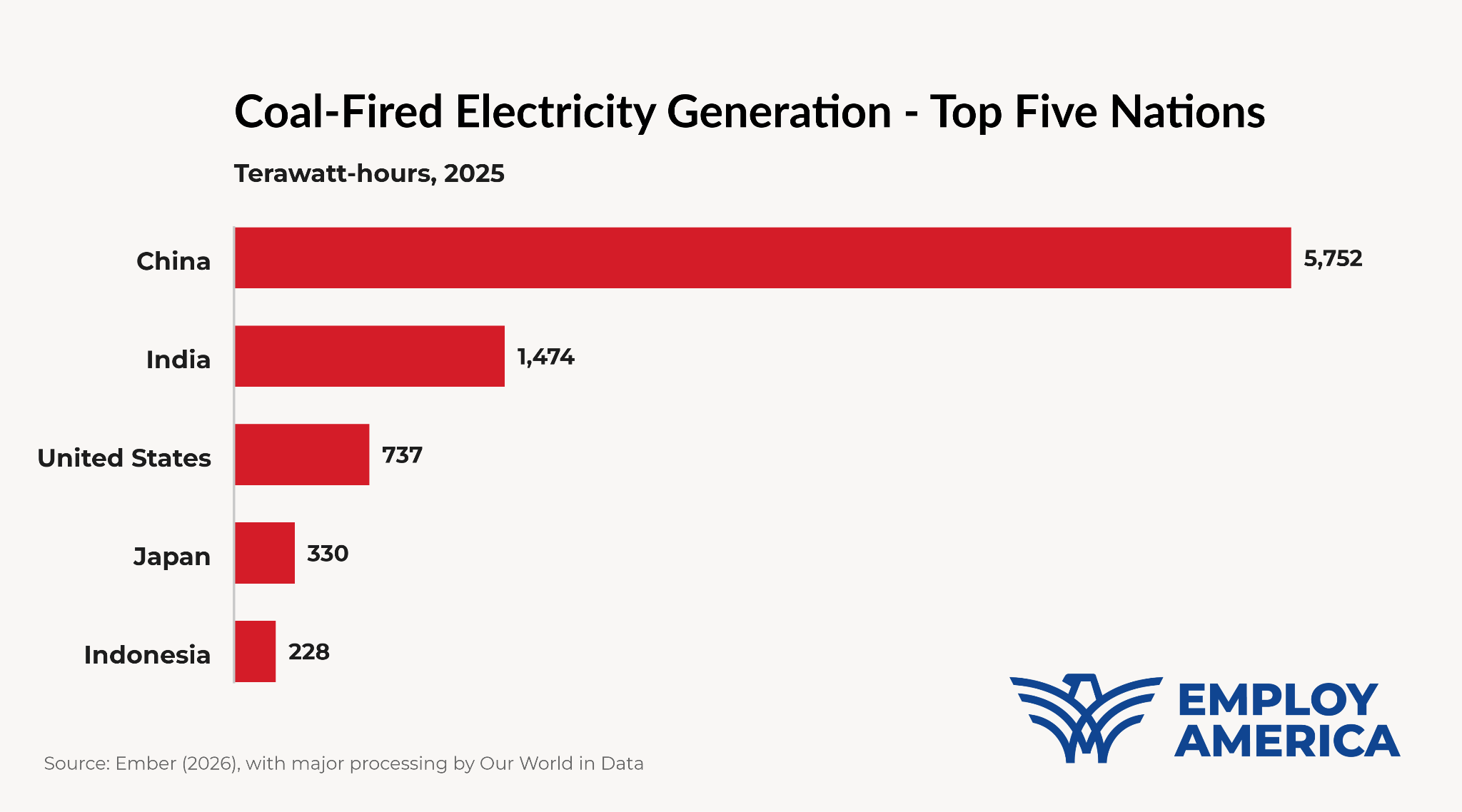
Worldwide coal consumption has continued to rise, despite its significant environmental costs, because it is a cheap fuel that can keep the lights on and power flowing irrespective of the weather, the temperature, or the time of day. In the electric power industry, this type of energy source is known as “firm” power, meaning it can be relied on by electric utilities and grid operators around the clock. Nations around the world that are seeking to increase their incomes and material prosperity through industrialization require firm power; historically this power came from coal.
In 2025, US power plants burned about 834 billion pounds of coal to produce 737 TWh (terrawatt-hours) of electricity. Given the US population is 343 million people, that is roughly 2,400 pounds of coal burned per American. Coal produced 17% of the 4,430 TWh of total US electricity generation in 2025. Moreover, US electricity generation from coal rose 13% in 2025 compared to 2024 due to a combination of factors including voracious electricity demand, cold winter temperatures, and higher natural gas prices causing dual-fuel power plants to burn more economic coal in lieu of natural gas.
However, the amount of coal electricity generated in the United States is far lower than it used to be. Coal electricity generation peaked in 2007, when an astonishing 2.1 trillion pounds of coal was burned in US power plants to generate 2,016 TWh of electricity. Coal power produced half of all US electricity in 2007. Most of the decline in coal generation can be attributed to the sharp rise in domestic natural gas production and subsequent fall in natural gas prices. This stemmed from the invention and commercialization of hydraulic fracturing technology which unlocked vast new quantities of natural gas that were previously inaccessible. Average US natural gas prices per MMBtu over the last five years have fallen by 58% in nominal dollars compared to 2005 prices and domestic natural gas production has doubled over the same period. This resulted in new natural gas power plants being more economically competitive than new and existing coal power generation. Similarly, solar and wind energy have both come down significant cost curves over the same time period, which resulted in an increase in their share of the total US electricity mix from 0.5% in 2005 to 19% in 2025.
As has been widely reported, there are large new electricity demands on the US grid stemming from the millions of Graphics Processing Units (GPUs) needed to power large language model based artificial intelligence. Although this technological development is a significant new source of electricity demand, it is not the only driver of load growth. The other two major drivers are the reshoring of industrial manufacturing and the increasing electrification of large swaths of the economy that have traditionally run on independently combusted hydrocarbons, such as home heating and transportation. Estimates vary, but a report from Grid Strategies estimates 65 GW (gigawatts) of peak demand growth from data centers, 20 GW from manufacturing, and 20 GW from electrification across the United States by 2029.
It is worth stepping back to remember that prosperity and energy consumption have always been intertwined. Economists often cite the tight correlation between electricity consumption per capita and income per capita. There are no high income countries that use small amounts of electricity. Electricity supports a more enjoyable personal livelihood, but it is also the basis for complex commercial activity that defines developed economies’ ability to generate high-quality, high-margin products and correspondingly high-quality jobs. That complexity historically came in the form of manufacturing. In the Pacific Northwest, for example, aluminum manufacturing only became viable after the construction of regional hydropower dams that could affordably supply the 3 GW of electricity required to power the factories. Reynolds Metals and Alcoa both built aluminum manufacturing plants in Washington state in the early 1940s, drawn by the cheap electricity from the Bonneville dam, which was sold for only $0.2 cents/kWh for 28 years. By 1956, the Pacific Northwest aluminum industry employed 11,400 people with average annual wages of $5,605, more than double the average American wage of $2,350 in the same year.
Politicians and Americans across the political spectrum decry the offshoring of US manufacturing, but rarely think about the power generation required to reshore advanced industry while remaining globally competitive. If elected officials from both sides of the aisle aspire to reshore energy-intensive industries, they will have to face up to a hard reality: the US faces a growing deficit of firm power generation, especially if we want to build a diversified portfolio that is hedged to handle natural gas supply and price shocks. Needless to say, we have a robust demand signal across sectors – from data centers, to industry, to broader consumer and business electrification. Now is the time to commercialize and deploy new sources of advanced firm power. Three categories of advanced firm power can – with further technological advancement and policy assists – be primed to help meet this moment: nuclear, geothermal, and long duration energy storage.
Investments in new sources of firm power were already warranted before the new spike in electricity demand because most US coal plants are quite old. The 189 GW US coal fleet is 48 years old on average. Data from the US Energy Information Administration shows that American coal power plants retire, on average, at 54 years old. Half of US coal capacity came online before 1980, and it will age out in one big wave. This problem is especially acute in the Midwest and Texas, which have the most end-of-life coal capacity due for replacement in the coming years.
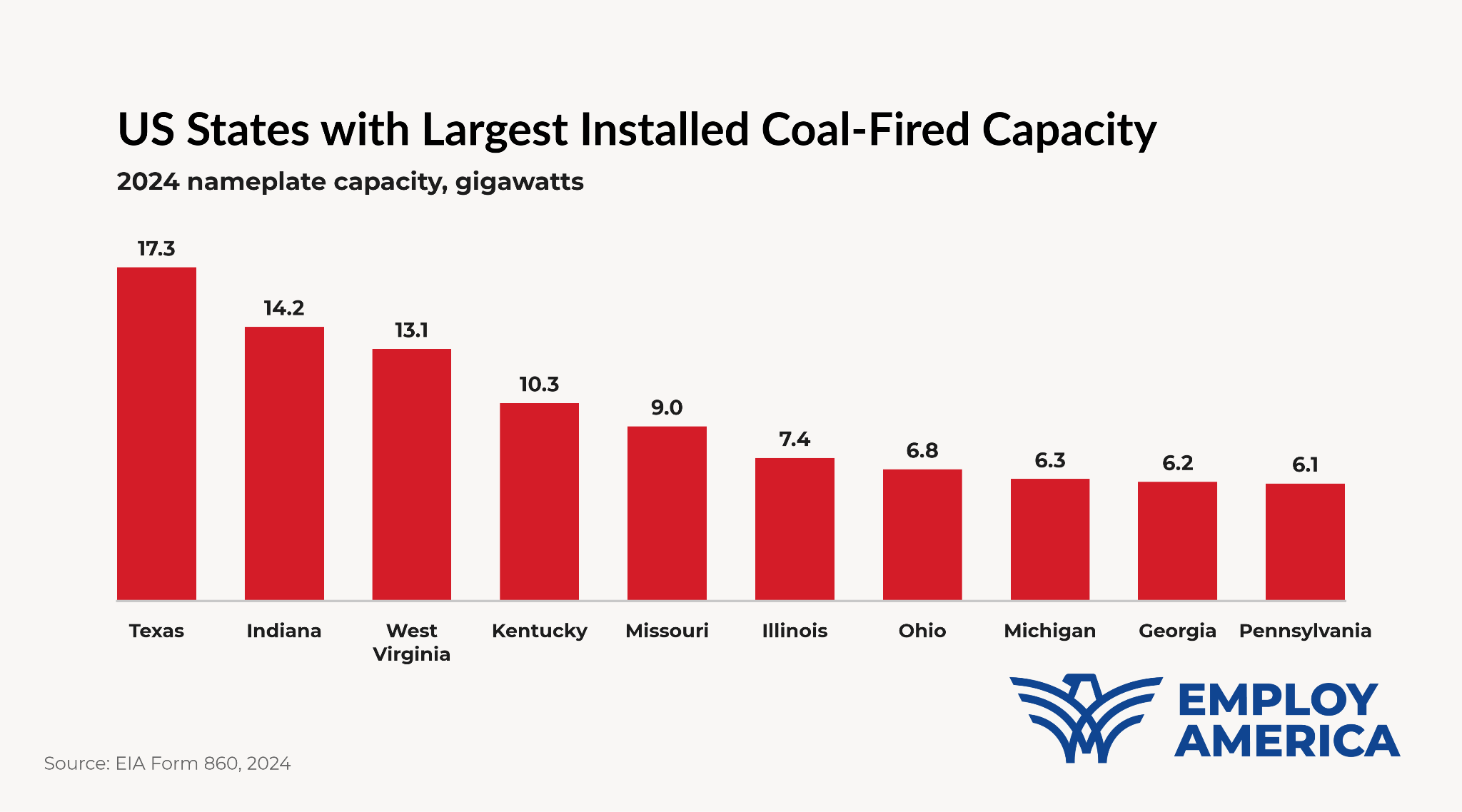
It is critical to acknowledge the strengths that baseload coal has had over other energy technologies in the pursuit of economic prosperity. Future investment policy efforts should prioritize technologies that share these strengths and have the highest potential for a true nationwide, multi-gigawatt buildout. Public dollars intended to support high-scale investment and commercialization — whether in the name of Energy Dominance or decarbonization — should be aligned with careful thinking about which technologies are most ready and best suited to capture those strengths.
To the extent policy efforts are focused on meeting the needs of electrification, industrial reshoring, or data center demands, the stakes of getting these questions right could not be higher. It will take a diversified portfolio to achieve the multiple energy, industrial, and economic goals that have been expressed within both parties and across the political spectrum.
President Trump is passionate about coal power and is right to recognize that coal is at the foundation of our modern world. The Trump administration Department of Energy has taken aggressive action to keep existing coal power plants online by issuing emergency orders under section 202(c) of the Federal Power Act, which prevented six coal power plants from retiring across the United States. However, new coal is almost certainly not going to replace our end-of-life coal capacity or meet the new load growth. The simplest reason: Western and allied companies lack an active, recently proven design – alongside the corresponding workforce and supply chain – to build new coal plants.
Large power plant designs and components are provided by industrial companies commonly referred to as OEMs, which stands for Original Equipment Manufacturers. These OEMs have all left the coal power plant business due to both environmental commitments and the rise of more competitive natural gas builds. The last new coal power plant to come online in the United States was the Sandy Creek Energy station in Texas, which was commissioned in 2013 and developed by LS Power. Significant financial challenges resulted in LS Power exiting the project in a 2021 bankruptcy proceeding and the turbine manufacturer Toshiba Corporation stopped taking new orders for coal fired power plants in 2020. They are not the only ones. General Electric, Siemens, and Mitsubishi have all exited newbuild coal. Outside of China and India, the supply chains and workforce required to build new coal generation do not exist and would necessitate significant resources and patience to re-establish, far more so than would be required for the most promising advanced firm power solutions other than natural gas.
A second paper tiger has emerged from those who continue to believe in the fantasy that the coal and load growth problem can be solved with 100% solar, wind, and four hour lithium-ion battery storage. Each of these technologies are impressive in their own right, and meet a significant and growing amount of US electricity demand. They are being built at gigawatt scale and their role can continue to grow in the American energy system. But the hard truth is that they cannot provide firm power alone. Sheldon Kimber, the CEO of Intersect Power and a big believer in and builder of new solar, admitted in a recent interview “a large data center with wind, solar, battery storage and some amount of firming gas can provide firm power.” Intermittent generation technologies and lithium-ion batteries still require natural gas for firm power.
Additional new solar also has diminishing returns on grids with high existing solar penetration. Newbuild solar generates power at the exact same time as all of the existing solar already on the grid; each incremental solar addition strengthens the correlation of intermittency risks and thus is less valuable to the overall system. The economics of newbuild solar and wind have also deteriorated due to the repeal of the federal tax credits in the One Big Beautiful Bill (OBBB).
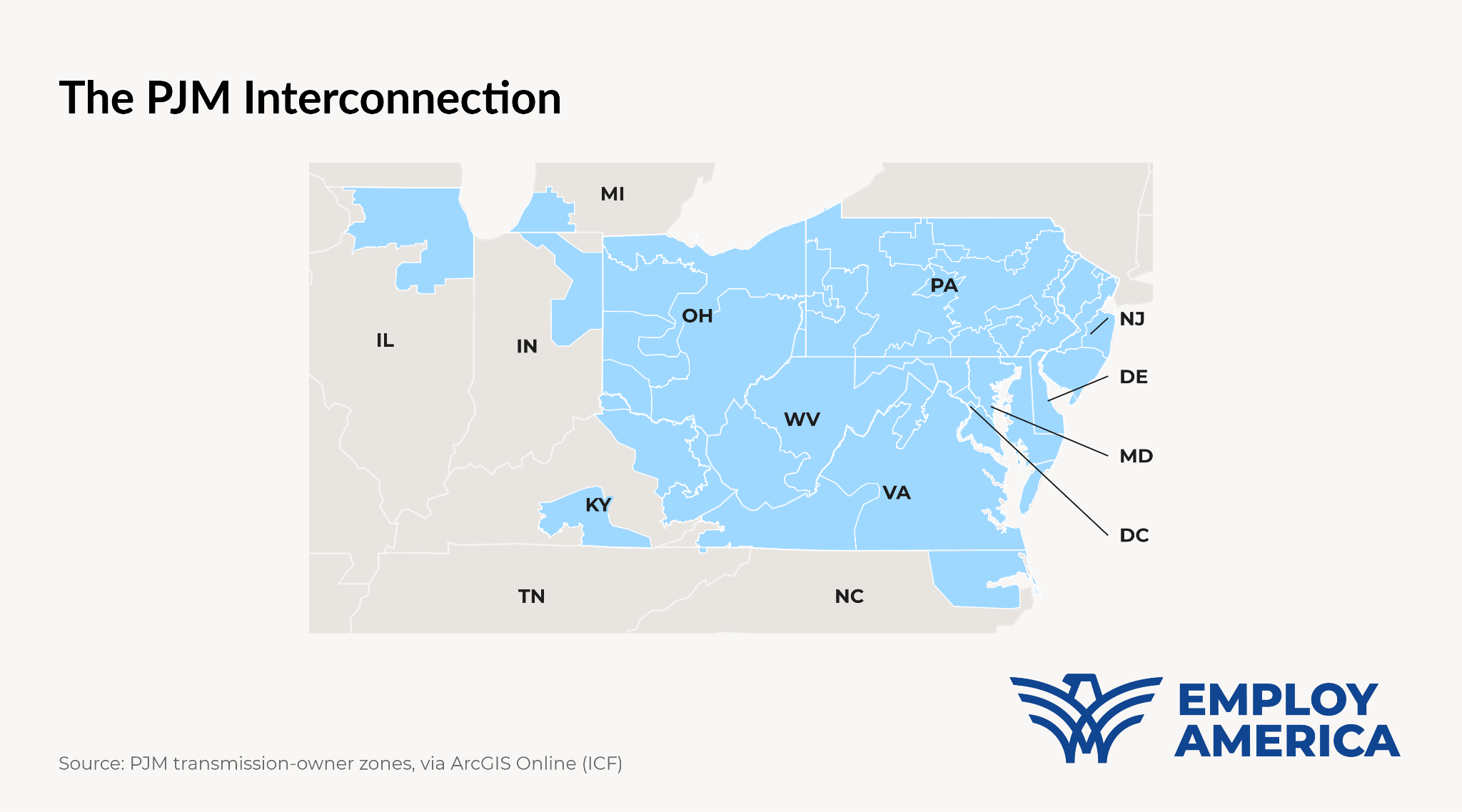
The maximum power a specific generator can produce is called the nameplate capacity. This is the number that is on the side of the tin for everything from a 5 MW community solar system to a 1 GW coal-fired power plant. In PJM, the largest electricity market in the United States, a market construct called the capacity market discounts the nameplate capacity of each energy generation resource based on when the technology can deliver power. Because critical infrastructure like hospitals and airports require electricity 24/7, the capacity market pays dispatchable “peaking” resources like diesel generators, simple cycle gas, and short-duration batteries to not run for most of the year, except for the few days or even hours where the system requires the generator to meet peak demand, like on a hot summer evening or freezing winter day. The nameplate capacity is lowered by PJM engineers based on a complex equation that calculates if the generator can deliver power during these peak demand hours. PJM publishes a percentage that determines the amount of nameplate capacity each type of generator can bid into the capacity market, that percentage is called the ELCC or Effective Load Carrying Capacity.
Because every new unit of marginal solar delivers power at the exact same time as all of the existing solar on the system, the ELCC of new solar on the PJM has fallen significantly over the last several years. In the 2024/25 PJM auction, tracking solar had an ELCC of 50% - meaning a new solar power plant was credited for 50% of its nameplate capacity in the capacity auction. By the 2026/27 auction, tracking solar had fallen to an 11% ELCC and it continues to fall to only a 4% ELCC for the 2034/35 auction. Technologies like nuclear maintain a very high ELCC of 93%-95% across auction periods because they generate electricity during the toughest hours, like at 3 am on a cold, dark, winter week when solar panels may be covered in snow.
Combined cycle natural gas power plants are the predominant preference of the major technology giants seeking power for data centers. Natural gas is already the largest source of US electricity generation, providing 41% of total electricity in 2025. The problem is that new natural gas is already bottlenecked. GE Vernova has a global gas turbine backlog of 53 GW and will not fill orders that are placed today until 2031. Similarly, Siemens has a 70 GW global backlog and Mitsubishi has a 35 GW global backlog.
The United States power system is already heavily reliant on natural gas, and based on decisions and developments over the past decade, it will continue to be for a long time to come. Large new natural gas builds are happening. 1,300 workers are currently on site building the 4.5 GW Homer City natural gas power plant at the location of a former coal plant in Pennsylvania.
The dominance of natural gas is already a given, and it would be prudent to diversify the energy system beyond natural gas alone. There is only one natural gas pipeline network and these power projects compete with other demands on the system like home heating, industrial processes, and new LNG export terminals. Employ America’s previous work illustrates how states with the highest penetration of natural gas generation experience the sharpest electricity price spikes when natural gas prices rise. Winter Storm Uri and the Russian invasion of Ukraine present two recent examples of how reliance on a single fuel, network infrastructure, and technology can drive up prices and impose steep harms. The combination of high load growth and an aging coal fleet make this moment ripe to develop additional paths to firm power where technology (1) sits at the cusp of commercialization, (2) offers unique value, and (3) leverages existing geographic and economic advantages. These advanced firm power solutions, if appropriately nurtured and catalyzed, can help the United States diversify its energy system.
The next generation of firm power comes in a variety of shapes and sizes. First up, the vinyl record of energy: gigawatt scale nuclear. Much like vinyl, large reactors were considered a relic of the 60s and 70s, but they are back in vogue due to their amazing attributes. Energy dense, air pollution free, 95% capacity factor powerhouses, large reactor designs like the Westinghouse AP1000 can match data centers’ load demands, and there is a growing body of evidence that they can both be built more quickly and come down the cost curve.
Next, there is the forgotten child of advanced firm power: hydroelectric power. This technology does not have as much room for exponential growth, but it deserves more focus than it has received. Industry and government could put real money into powering up the 97% of existing dams across the nation that do not generate any electricity. An Oak Ridge National Lab report estimates such a strategy could unlock as much as 15.2 TWh of additional annual generation. Moreover, existing hydro facilities can upgrade their turbines to boost power generation by around 20% while becoming more fish-friendly. This is extra firm capacity hiding in plain sight. Hydroelectric power resources also give rise to a related opportunity: pumped hydro storage, which is the oldest and largest form of long duration energy storage in the United States. There is a significant amount of new pumped hydro storage under development across the country, with 60 GW of projects either applying for permits or under construction. Closed loop pumped hydro projects like Swan Lake Energy Storage in Oregon are filled with water once and then function as giant batteries for many decades.
There are a bevy of other long duration energy storage technologies that are also commercialized and scaling deployment. Form Energy’s iron air batteries use rust to store energy for multi-day periods. Secretary Wright and Senator Collins recently visited Lincoln, Maine where Form Energy plans to build an 8.5 GWh battery at the site of a former paper mill. Hydrostor has a compressed air energy energy storage system that can discharge for 8 to 24 hours, with one of their first US projects being built in Kern County, California.
Finally, enhanced geothermal systems, which use drilling technology from the oil and gas sector to open up geographies previously inaccessible under conventional geothermal development, are garnering an increasing share of attention as a new source for firm power. Companies like Fervo Energy and Sage Geosystems are using the horizontal drilling and hydraulic fracturing techniques first pioneered by the oil and gas industry to tap hot rocks, heat water, and generate electricity. One of the most compelling elements of this technology is how it leverages the drilling expertise and experience of the existing US oil and gas workforce.
This diverse array of advanced firm technologies share common challenges. The technologies are past the pure laboratory demonstration phase of development, and are now facing the project execution risks that stand in the way of true commercial viability and maturity. Many of these projects are first-of-a-kind (FOAK), meaning they face financing and cost premiums compared to building the next combined-cycle natural gas power plant, a fully mature technology that has been built hundreds of times across the United States. On the other hand, OBBB maintained the federal Investment Tax Credit and Production Tax Credit for these technologies through 2032. OBBB terminated the tax credits for new solar and wind projects that had not commenced construction by July 4, 2026. These tax credits, however, come with a series of barriers that challenge their monetization and maximization, and therefore limit their potential to scale these technologies and bring them down the cost curve. Employ America is doing careful work on the financial modeling, tax credit mechanics, and relevant federal lending programs to unlock these shared challenges.
We are focusing our efforts, to start, on the Trump administration’s efforts to scale nuclear reactors like the Westinghouse AP1000, a gigawatt scale fully commercialized nuclear power plant. The United States and China started building this next generation of nuclear power around the same time in the late 2000s, and the initial projects in both counties ran severely over-budget and behind schedule. Design deficiencies, supply chain limitations, and workforce challenges contributed to cost and schedule overruns. American utilities and public utility commissioners understandably pulled out: only two projects broke ground, only one project completed, and currently zero new projects are under construction. China ran into similar issues on supply chain, workforce, schedule, and cost. But they took the growing pains from their first set of reactor builds, learned from them, and proceeded to build more. These subsequent builds have seen material improvements on both cost and schedule. China has 33 large nuclear reactors under construction today. There is no good reason why — under the right policy and market circumstances — the same cannot happen in the US.
The Trump administration was wise to put the full force of the federal government behind an effort to have 10 large light water reactors break ground by 2030, as outlined in the May 2025 executive order. That journey is poised to start with the effort to finish the VC Summer AP1000 reactors in South Carolina. There are several significant barriers to meeting the administration’s admirable 10 reactor goal across policy, finance, and supply chains - Employ America is working on solutions to each of these dimensions actively. We will have more to publish on these issue areas in the coming weeks and months, and our strategies will carry relevance that extends to other advanced firm power technologies.
The United States is in the midst of a significant firm power deficit that is already making electricity more expensive for many Americans and risks stifling our economic competitiveness. This problem will be exacerbated by the impending retirement of large amounts of the existing US coal fleet that is at end of life. This retiring coal capacity is unlikely to be replaced by new coal given major OEMs’ exit from the newbuild coal market. It also cannot be replaced by solar, wind, and 4 hour lithium batteries alone. Just as has occurred in the United States for the last several decades, much of the retiring capacity will be replaced by new combined cycle natural gas - but it is unwise to leverage the entire energy system to a single technology or resource. The moment is ripe for policymakers to complement large new natural gas builds with efforts to support gigawatt scale deployment of the advanced firm technologies that are on the cusp of prime time: licensed nuclear reactors, enhanced geothermal, upgraded hydro, and long duration energy storage. Employ America has developed models, frameworks, and structured solutions that may prove vital to these technologies scaling and helping resolve our shared power crunch.