Fission Possible Part I: New Nuclear Can Pencil with Better Policy Implementation
The Trump administration has the opportunity to unlock the powerful financing tools passed by Congress



The Trump administration has the opportunity to unlock the powerful financing tools passed by Congress
There is bipartisan support among both policymakers and the general public for expanding safe and reliable nuclear power to meet growing demand for electricity. On May 23, 2025, President Trump signed Executive Order 14302, which set a bold goal: commence construction on 10 new large nuclear reactors in the United States by 2030. The most likely candidate for fulfilling this goal is the Westinghouse AP1000, the only fully licensed design that has been recently constructed in the United States. Two AP1000 reactors, Vogtle Units 3 and 4 in Georgia, entered service in 2023 and 2024, respectively, and are now generating large amounts of firm “always on” electricity. The Vogtle project — the first set of new nuclear reactors fully built in the United States in over a generation — was completed significantly behind schedule and over budget. Consequently, financiers and the electric utility industry have been reluctant to embark on the next set of AP1000 projects, and nuclear projects more broadly. New financial modeling from Employ America is set to reveal a credible path to allaying investors’ fears — new nuclear projects can “pencil” for equity investors if the Trump administration unleashes the full power of the financing supports each party backed when it controlled Congress. This credible path to investment viability for new nuclear hinges on administrative policy actions that unlock the full value of what Congress has enacted, specifically with respect to the §48E Investment Tax Credit.
The Fission Possible series from Employ America will detail how new nuclear construction projects can pencil — projects are financially viable and attractive under an attainable set of financial and policy assumptions. Key to establishing these conditions is a set of administrative actions that can maximize the potential of the §48E Investment Tax Credit, which plays a critical role in shaping financial returns for nuclear projects. The next piece in the series will break down the assumptions, calculations, and insights stemming from our financial modeling of a hypothetical AP1000 project. This will be followed by pieces that identify how administrative implementation of §48E can be improved, including Domestic Content Requirements, Direct Pay monetization, and the Energy Communities bonus.
Employ America’s financial modeling demonstrates that the next two AP1000 reactors can “pencil” for investors across several scenarios. By “pencil,” we mean that new AP1000 projects can achieve the requisite internal rates of return (IRRs) and returns on equity (ROEs) under relatively conservative construction cost assumptions. Project equity can earn mid-teens returns, comparable to other large renewable infrastructure projects, even in a scenario where the next pair of AP1000 reactors are built at the same high construction costs as the Vogtle project. This is a conservative assumption because the Vogtle project broke ground with an incomplete reactor design, had to stand up a workforce and supply chain from scratch, and overcame the bankruptcy of its lead construction contractor in the middle of the build phase. The project also faced additional construction delays stemming from the once-in-a-generation global pandemic. These unique factors resulted in significant cost escalation that the next reactor builds should be able to avoid. In fact, significantly greater upside exists for investors who facilitate stronger project execution than the Vogtle project experienced.
Employ America has dedicated significant resources to building a robust financial model of a two-reactor AP1000 project, the only project type with both a completed design and a recent construction track record in the United States. We conducted an extensive literature review of other AP1000 financial modeling efforts, and also pulled specific line item costs from the Vogtle project’s public filings to strengthen our estimates. We built our financial model in collaboration with Pooja Reddy, an investment banker with significant experience in capital-intensive and regulated industries, and with previous transaction experience in infrastructure project finance.
The financial viability of the next AP1000 projects, when using conservative assumptions of total capital expenditures, depends on the Trump administration both unlocking the full potential of the §48E Investment Tax Credit (ITC) and deploying the lending power of the Department of Energy’s Office of Energy Dominance Financing (DOE EDF). This memo goes through the range of implementation barriers that are currently stymieing the full potential of the ITC, and is the first in Employ America’s series exploring how a revitalized ITC, paired with DOE EDF lending, can catalyze the promised nuclear launch.
The ITC is one of the two principal tax credits authorized by Congress to incentivize new emissions-free electricity generation; the other is the §45Y Production Tax Credit (PTC). The ITC is calculated as a percentage of total eligible project costs and is traditionally claimed in the tax year when the project is placed in service, commonly called the Commercial Operations Date (COD). The PTC, on the other hand, is calculated based on the amount of electricity, measured in kilowatt-hours (kWh), that a project generates once operational during the 10-year credit window. Both credits are claimed by the project owner during tax season. The ITC should, at least in theory, be far more valuable than the PTC for new nuclear projects due to their high upfront capital costs, as shown in analysis within DOE’s Pathways to Commercial Liftoff: Advanced Nuclear report. Given this, our analysis focuses solely on strategies to unlock the ITC.
The One Big Beautiful Bill (OBBB), passed by a Republican Congress in 2025, maintained the full ITC for new nuclear projects that commence construction by 2033, even as OBBB made many other changes to energy policy relative to what was legislated under a Democratic Congress in the Inflation Reduction Act (IRA) of 2022.
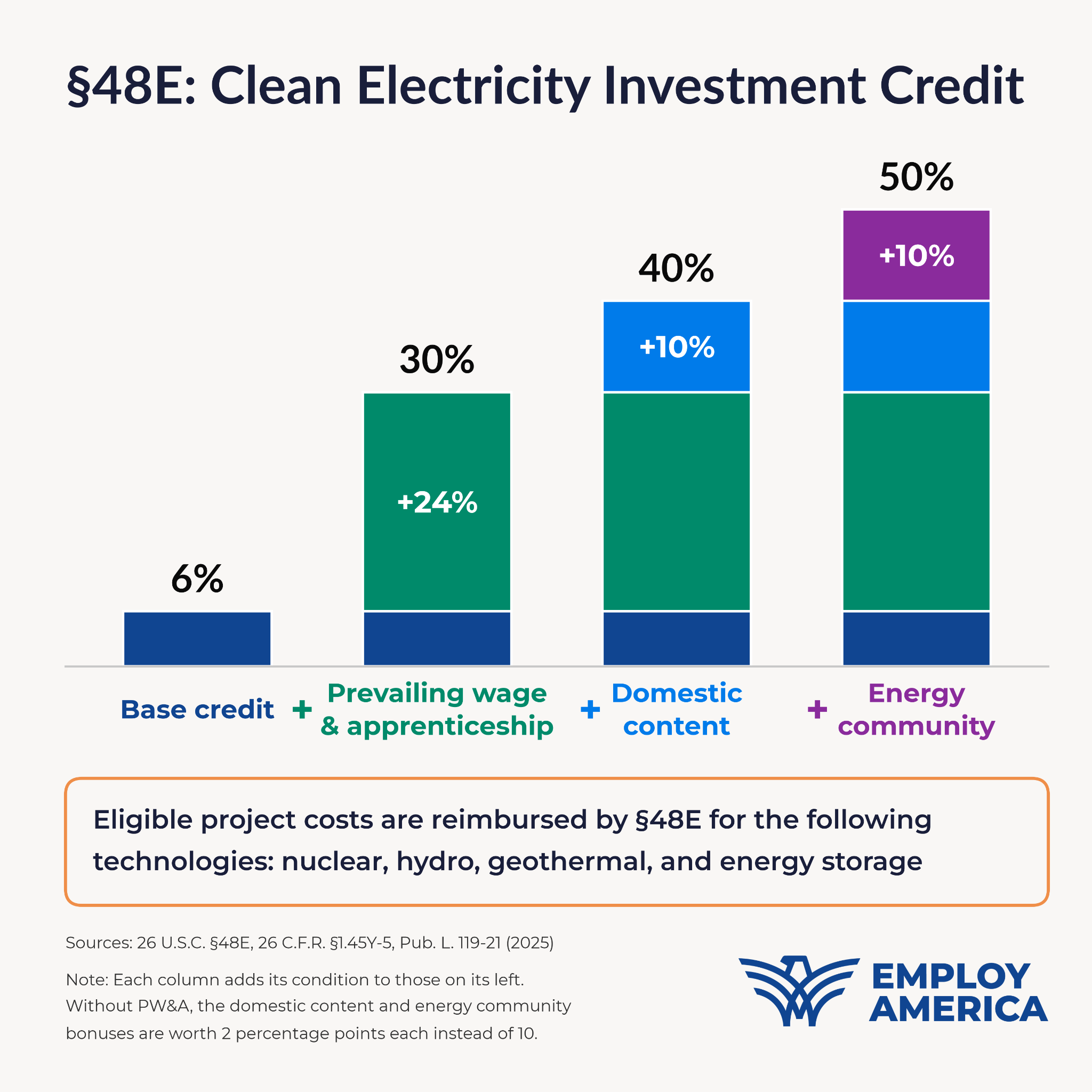
The base and bonus structure of the ITC is consistent across the IRA and OBBB, and breaks down as follows:
At first glance, the current ITC seems incredibly valuable for new nuclear. Leaders at the Department of Energy have occasionally touted the ITC provisions as “buy one reactor, get one free” — a compelling proposition for utilities and project developers. Unfortunately, the guidance issued during the Biden administration established a much more challenging environment to fully monetize the ITC for new nuclear construction projects. There are at least five major roadblocks keeping the maximum ITC out of reach for developers of new nuclear:
Assuming that a new nuclear project earns a 50% ITC, it is unclear whether the tax equity market is deep and liquid enough to monetize what would amount to a $10 to $17 billion tax credit for a single two-reactor build. The tax equity market refers to the group of buyers and sellers trading energy tax credits issued by the federal government. The IRA, passed by a Democratic Congress in 2022, enabled energy tax credits to be transferred and sold at scale for the first time, as described in 26 U.S.C. §6418. This provision of the law aimed to address the issue of energy project developers not having the requisite tax liability to monetize tax credits on their own books. The new transferability regime enabled project developers to legally sell and transfer the tax credits to any willing buyer with a large enough tax liability to monetize the credit. New markets formed: tax credits were traded privately between different parties, with banks acting as intermediaries, and traded on new online tax equity marketplaces like Crux. The OBBB accelerated the phaseout of tax credits for traditional renewables and prohibited tax credit transfers to specific foreign entities of concern, but otherwise left the transferability regime established by the IRA in place. The federal government collected a total of $452 billion of corporate income taxes in FY25. Setting aside the misalignment of corporate tax reporting years with federal budget years, the closest publicly reported proxy of a company’s federal tax liability is the ‘current federal income tax expense’ that companies report in their annual 10-K filings to the SEC. Individual companies also calculate this figure differently, but the general scale of the figures is what matters. The top five public companies with the largest federal income tax expense in their most recently reported fiscal year were:
Corporate income taxes are noisy, full of one-time payments, deferrals, and a litany of additional intricacies that muddy these simplified figures. Even when read with error bars, these numbers do provide a ballpark for estimating the maximum possible ITC that could be monetized by an individual corporation in one tax year. DOE estimated in 2024 that the last two AP1000s were built at an overnight capital cost of ~$11,000/kW, which the report inflation adjusts to ~$15,000/kW in 2024 dollars. Most public cost modeling, including a separate estimate from the DOE, assumes that the next two AP1000s would come in below $15,000/kW. Employ America will publish the results of our own cost modeling in future pieces. Even so, the $15,000/kW figure provides a reasonable ceiling estimate on the total cost for the next two reactors, and therefore acts as a helpful high-water mark on the potential quantum of a 50% ITC. If the next two AP1000s were built at $15,000/kW, the total project cost would be $33.5 billion and the 50% ITC would be close to $17 billion, larger than all but one annual corporate tax bill.
There is some potential for a consortium of corporations to jointly monetize portions of such a gargantuan ITC. Offshore wind is the closest comparable: Vineyard Wind 1 closed on what was described as “the largest single asset tax equity financing” deal in United States history with JPMorgan Chase, Bank of America, and Wells Fargo in 2023. But even the size of that tax equity package, $1.2 billion, is an order of magnitude smaller than what is required for two new AP1000s. The purpose of the transferability regime was to enable energy tax credits to be sold and transferred to entities that have the requisite tax liability to monetize the credits, but there is a very short list of entities capable of absorbing even a portion of the tax credits that a new large nuclear project would generate. The purchasers of these tax credits, upon realizing their significant market leverage, would be able to demand a steep haircut per dollar of credit, diluting the value of the tax credits for the nuclear developer. It is challenging to estimate what size haircut an ITC would take for a new nuclear build, given that a transaction of this scale has never occurred. The energy tax equity marketplace Crux reported in its 2026 Mid-Year Market Intelligence Report that ITCs transacted at an average of $0.91 on the dollar in the first half of 2026, representing a 9% haircut for project developers. However, the idea that a nearly $17 billion ITC could be successfully monetized at this same 9% haircut warrants significant skepticism given that Crux also estimates that the total size of the entire tax credit transferability market in 2025 was $42 billion. Based on this assessment of the market’s depth, a transaction for a pair of AP1000s could easily exhaust potential purchasers of the tax credits.
Utilities and state governments are only in the initial phases of grappling with how the ITC would be practically monetized. New York Governor Kathy Hochul called for a 5 gigawatt new nuclear backbone to be constructed in New York State. NYSERDA and NY DPS released an Advanced Nuclear Policy Options paper laying out in extensive detail a strategy for the state to procure additional nuclear power. The paper models a 40% ITC for new large light water reactor projects, but “does not include a quantification of the transaction costs” on the tax credits themselves. The scale of the transaction costs is indeed a black box, but simple supply-demand reasoning suggests that the haircuts on transacted tax credits would be unprecedentedly steep under current policy. Solutions must be brought to this tax equity monetization challenge because the ITC represents the linchpin tax incentive for building modern nuclear reactors, which would represent some of the most ambitious commercial power projects ever pursued.
Even assuming that the ITC can be monetized without a steep haircut, the timeline for monetization is generally suboptimal for developers and ratepayers. Treasury regulations for the ITC state that tax credits are typically earned the year that the power plant is “placed in service,” what developers commonly refer to as the Commercial Operations Date (COD). Construction timelines between the pouring of first nuclear concrete and the project COD can span the better part of a decade. The “backloaded” nature of the ITC significantly dilutes its net present value for the nuclear developer. At a 7–10% cost of capital, a dollar of credit arriving eight years later is worth roughly half as much as it would be at Final Investment Decision (FID), when the developer first commits capital to construction. Banks could offer bridge financing to help developers capture the value of an ITC monetized in the future, but that path involves additional value dilution via transaction costs, bank fees, and interest rates.
Regulated investor-owned utilities (IOUs) are typically subject to ‘normalization’ requirements when claiming Investment Tax Credits for any new assets they develop and own. Normalization is an arcane feature of public utility accounting and tax law that requires any tax credits earned by IOUs to be “normalized” across the lifetime of the asset, as stated in §50(d)(2). Put simply, this requirement prevents an IOU that builds new nuclear from passing their ITC windfall along to ratepayers immediately — instead they can only pass the savings on to ratepayers extremely gradually, over the multi-decade lifespan of the new nuclear power plant. The perverse result: the public utility commission that oversees the IOU is less likely to approve the construction of new nuclear because the savings from the ITC cannot be passed on to ratepayers promptly, making the project look artificially expensive on ratepayer bills in the short run.
The high price tag of new nuclear will be easier to stomach for developers, public utility commissions, and ratepayers if there is a clear path to the projects earning the full 50% ITC. That path does not exist today for either of the 10% bonus credits. The first, the Domestic Content bonus, requires that new nuclear projects meet a two-part requirement:
The test starts with a nuclear power plant being broken down into distinct systems, referred to as “Applicable Project Components” (APCs). These macro-level APCs are classified as either structural ‘Steel and Iron’ products or ‘Manufactured Products.’
The federal government has yet to release information on what the APCs of a nuclear power plant are, or how the APCs are categorized into either the ‘Steel and Iron’ category or the ‘Manufactured Products’ category. The Treasury Department issued Notice 2023-38, which states that the ‘Steel and Iron’ requirements only apply to “construction materials that are made primarily of steel or iron and are structural in function” — this is somewhat helpful, but more specifics are needed in order for nuclear developers to accurately classify all of the components of a nuclear power plant into the correct category. It would be especially helpful if the Treasury released Safe Harbor Tables that define APCs for nuclear projects and provide standardized cost percentages. Treasury has already issued tables for other energy technologies including hydro, solar, wind, and battery energy storage systems. Treasury should take a careful approach for nuclear that both incentivizes domestic manufacturing and recognizes the complexity of nuclear power plants and the supply chains for their subcomponents. Many of these subcomponents are unlikely to be manufactured domestically on a reasonable timeline. If classification is conducted with prudence, a pathway for new nuclear to earn the Domestic Content bonus can be preserved within the constraints of the global supply chain.
The second 10% bonus — the Energy Communities bonus — is earned when a new nuclear project is constructed in specific parts of the country, but the implementation was poorly calibrated to the sites best suited for the next wave of nuclear construction, namely at existing nuclear sites. The pathway for most existing nuclear sites to capture the Energy Communities bonus runs through a definition the Treasury Department suboptimally implemented, making it excessively unstable for investment planning.
To satisfy the Energy Communities bonus, the new nuclear project must meet at least one of the following definitions:
These definitions are complex enough that the Treasury Department had to clarify which sites do and do not qualify. Treasury published a 44-page document laying out their methodology to determine the full list across the second and third definitions. It updates this list every year because the qualifying locations change over time.
The first and third definitions are relatively stable and aligned with what is generally required to target investment, in contrast to the second definition. They tend to only expand their geographic scope over time, and do not remove any geographic location that has previously qualified. On the other hand, the second definition, as currently interpreted by the Treasury, is highly unstable because of how local area unemployment rates are estimated and compared to the national average. Sites that satisfy this Energy Communities definition in one year can easily fail to do so in a subsequent year, thereby making it difficult to plan investments into these sites.
The unfortunate fact for nuclear and other ITC-supported technologies is that the first and third definitions, despite their stability, are poorly suited to the other geographic factors relevant for siting development. The next wave of new nuclear projects is likely to be built at the sites of the existing nuclear fleet. Existing nuclear sites have benefits including established interconnection infrastructure and strong support from local communities who recognize the benefits of hosting nuclear power. The first definition disfavors sites that previously required permits related to the Clean Water Act, which disfavors existing nuclear sites. The third definition is useful for existing or previous coal sites, but offers little relevance to new nuclear projects planned at existing nuclear sites. Employ America will discuss these issues in greater detail in a forthcoming piece on the limitations of Energy Communities definitions.
If existing nuclear sites are to capture the Energy Communities bonus for the ITC, the second definition will need an implementation overhaul. There is no way for a nuclear developer to site a project — a decision made years in advance of when construction actually commences — to ensure that the second Energy Communities definition is satisfied based on the current IRS guidance. Employ America will be publishing a detailed whitepaper outlining our potential solutions for making the bonus substantially more effective through revised IRS guidance.
There was a flawed attempt in the OBBB to create a fourth Energy Communities definition to grandfather in existing reactor sites. This definition only applied to the PTC and was explicitly made inapplicable to the ITC. This attempt at grandfathering also comes with its own deficiencies, and has thus complicated the IRS’s ability to provide the requisite guidance to make this definition fully usable for nuclear developers interested in pursuing the nuclear PTC.
Taken together, this litany of challenges highlights the gulf between the “buy one, get one” claim and the tough policy reality on the ground. The good news is that these challenges can be addressed. In fact, a bold administration can address these issues credibly without additional congressional action.
The discussed problems could be solved by passing bills through Congress. Multiple pieces of legislation have been introduced that are targeted at some of these challenges, including bills introduced by Representatives Pat Harrigan and Dan Newhouse as well as Senator Tim Scott.
The Department of Energy has signaled that they are interested in pursuing legislative solutions to these ITC challenges. DOE EDF Director Greg Beard and Acting Chief Investment Officer Julie Kozeracki joined Thomas Hochman on the Right of Way Podcast to push Congress to pass legislation that would deliver a range of fixes to the ITC for new nuclear development. Employ America is supportive of these efforts, but legislation is always a challenging exercise. What may prove more promising: an alternative pathway to those same policy outcomes, but based solely on administrative actions and authority.
Congress has already legislated a solution that allows a certain class of project owners to bypass many of these ITC challenges: Direct Pay. This provision of the tax code, which is also referred to as Elective Pay, bypasses the need to sell the ITC through “transferability” and allows a project developer to monetize the value of the tax credit as a direct cash payment from the IRS. The steep haircut that a developer would face by selling the tax credit would be fully avoided. Direct Pay under current law also allows the project owner to monetize the ITC through Qualified Progress Expenditures (QPEs). QPEs allow a portion of the ITC to be paid out every year based on construction spending during that year, rather than in one lump sum at project COD. Current law bans the transfer (sale) of QPE tax credits into the tax equity market, but Direct Pay bypasses the need for transferability altogether. It is hard to overstate how transformative these payments during construction would be for improving project economics and lowering perceived project risk.
The success of Direct Pay and QPEs as an ITC monetization mechanism can be seen in a different industry with similar levels of capital intensity: semiconductors. The bipartisan CHIPS Act of 2022 provided direct funding and tax credits to encourage domestic semiconductor fabrication in the United States. $38.2 billion of direct funding was appropriated by Congress for FY2022 through FY2026 for manufacturing incentives, with awardees selected by the Commerce Department. Additionally, the law created the §48D ITC (unrelated to the §48E ITC that applies to nuclear). The §48D ITC provided a 25% tax credit for qualifying semiconductor advanced manufacturing facility investments that break ground by the end of 2026. Notably, the law allowed for-profit chip manufacturers to claim their tax credits using Direct Pay and QPEs. The CHIPS Act achieved its desired goal: billions of new investment dollars flowed into semiconductor production on domestic soil. In fact, estimates on uptake of the §48D ITC have been larger than what was initially anticipated by the Congressional Budget Office. At least some of this outsized uptake can be attributed to the frictionless mechanics of Direct Pay and QPEs.
There are two challenges to making Direct Pay and QPEs viable for the nuclear ITC. The first is that claiming Direct Pay requires that a nuclear project also satisfy virtually the same Domestic Content Requirements as those specified for the 10% Domestic Content bonus. This requirement magnifies the importance of the federal government issuing Domestic Content guidance that enables a path for new nuclear to earn the Domestic Content bonus within existing supply chains. The second challenge appears more daunting. The current statute states that Direct Pay can only be claimed by the following entities:
It is essential to appreciate that access to Direct Pay depends on how the IRS defines and determines the owner of a particular project. The IRS’s inquiry is highly qualitative, doctrinal, and substantive. In some important ways, this inquiry diverges from conventional understandings of ownership. Employ America has identified a potentially viable pathway for IOUs and Independent Power Producers (IPPs), by contracting with and for a tax-exempt entity, to access the benefits of Direct Pay and QPEs for §48E ITC projects. This pathway would also allow IOUs to potentially avoid normalization requirements. Employ America will offer more details about this potential pathway in a separate piece.
In an ideal world, the IRS would adopt additional guidance that provides a safe harbor framework for defining the ownership structures that are eligible for Direct Pay under the §48E ITC. This outcome is economically desirable, legally feasible, and politically aligned with the administration’s broader energy policy objectives. If guidance proves too time-consuming to promulgate, private developers and tax-exempt entities can pay for a Private Letter Ruling from the IRS to assess eligibility for Direct Pay in their specific circumstances.
Direct Pay and QPEs are most valuable for new nuclear if they are paired with a full 50% ITC. The path to earning a 50% ITC is not clear today for new nuclear — but it can be. The clarification required to unlock the 50% ITC pathway can even be achieved without congressional action, and the simplicity and speed of this solution is worth pursuing.
First, the Treasury Department and the IRS can promulgate a Domestic Content Safe Harbor Table that is strategically structured to account for the complexity of new nuclear, its existing supply chains, and the reality that final manufacturing processes are occurring in the United States. This is critical to enable both the 10% Domestic Content bonus and the only Direct Pay pathway for the ITC that does not require new legislation.
Second, the validity of the existing Direct Pay pathway could be formalized through additional IRS guidance, or, more narrowly validated through individual Private Letter Rulings. Tax-exempt organizations can serve as project owners for the purposes of the IRS and the Nuclear Regulatory Commission by taking on certain requisite burdens, while still giving developers and utilities the upside and project risk profile that they seek. The incomplete V.C. Summer project in South Carolina is one example of an AP1000 project that could benefit from identifying a structure that maintains sufficient ownership burden on the tax-exempt entity, even as there are contractual arrangements involving a for-profit developer. Santee Cooper, a state-owned utility eligible for Direct Pay, remains the official owner at V.C. Summer, even as it has sought out Brookfield, a private for-profit entity, to lead the development efforts. If the ownership structure and contractual arrangements can satisfy all relevant tax laws and doctrines, the ITC for V.C. Summer’s development could be monetized through Direct Pay & QPEs. Employ America has identified the potential for such an ownership structure that could still satisfy the relevant tax and nuclear regulatory considerations for ownership.
Third, the Treasury Department can revise the Energy Communities guidance to align it with the realities of project development timelines for technologies that currently qualify for the ITC. The original Energy Communities guidance was implemented suboptimally and remains poorly aligned with any technology that involves substantial pre-FID reliance interests. Revised guidance could yield a more functional and stable definition compared to the one Treasury originally adopted, which ignored some basic realities of how the Bureau of Labor Statistics develops its estimates. Employ America has identified an alternative interpretation of the statute that is superior on legal, statistical, and economic grounds. As noted earlier, Employ America will lay out the full set of issues associated with the current Energy Communities guidance, which inadvertently puts a thumb on the scale against technologies that involve higher upfront costs prior to construction.
The US Treasury Department can demonstrate its commitment to following through on the 10 reactor goal articulated in President Trump’s 2025 Executive Order by using its administrative authority to unlock the full force of the ITC for new nuclear. Absent Treasury action, these fixes would require a rare bipartisan window to pass complex energy tax law revisions — an admirable but substantially more speculative proposition.
The United States invented and commercialized civilian nuclear reactors: a safe, clean, and reliable way to generate large amounts of electricity. The financial support Congress has passed, with Democratic and Republican endorsement, can open up a real chance to scale the relevant learning curves and bring down costs. The promise of delivering new large nuclear projects on time and on budget is simply too valuable — whether for economic security, technological leadership, or broader prosperity — to pass up.
Employ America’s forthcoming public financial model indicates that the future of nuclear deployment is quite bright, but it hinges on maximizing the tools that Congress has already passed on a bipartisan basis. The next AP1000 projects will struggle to pencil with DOE EDF debt alone, and will require that debt be paired with a revitalized ITC. ITC fixes can occur through new legislation, but there is a more straightforward path that relies solely on administrative action. Employ America will publish a series of pieces that show how this pathway can be realized across the dimensions of Domestic Content, Direct Pay with QPEs, and Energy Communities.