Trade the SPR, Save the SPR
SPR deliveries are back on the menu.


SPR deliveries are back on the menu.
If another emergency SPR release is necessary, the United States has an opportunity to convert today's high-value barrels into both future replacement barrels and much-needed physical upgrades for the reserve.
There is a policy choice for future deliveries: another exchange would perhaps yield an additional five to ten million barrels. Alternatively, a sale followed closely with forward repurchases could restore the SPR inventory while improving the SPR's long-term health and viability. The tradeoff is whether those infrastructure improvements outweigh the additional barrels.
The currently used exchange mechanism maximizes the number of barrels in the SPR, earning a premium once barrels are returned. The result is that the SPR, by the end of this cycle, could end up at a higher level than prior to the Iran conflict. Those barrels have value, but if future deliveries are made, we propose using a sale-and-repurchase strategy to improve the long-term health of the SPR.
Such a “trade” would follow three steps:
Deliver up to 39 million barrels to the market via the President’s emergency drawdown authority (a sale);
Contract forward for the same number of barrels at a fixed price; and
With Congressional authorization, put the remaining funds towards the backlog of Life Extension II repairs.
The exchange mechanism utilized by the Trump administration has yielded value — all else equal, DOE will receive an additional 25–30 million barrels, and the SPR could even be refilled above pre-war levels.
But oil stored in the SPR is not the asset — the value comes from the ability to release and acquire, which is determined by the state of the infrastructure itself. By pursuing a sale-and-repurchase strategy, the Trump administration can improve the long-term health of the asset.
The oil market has steadily grown more backwardated over the past month—meaning oil for delivery today is increasingly more expensive than oil for delivery in the future—and spot prices have eclipsed $100 per barrel.
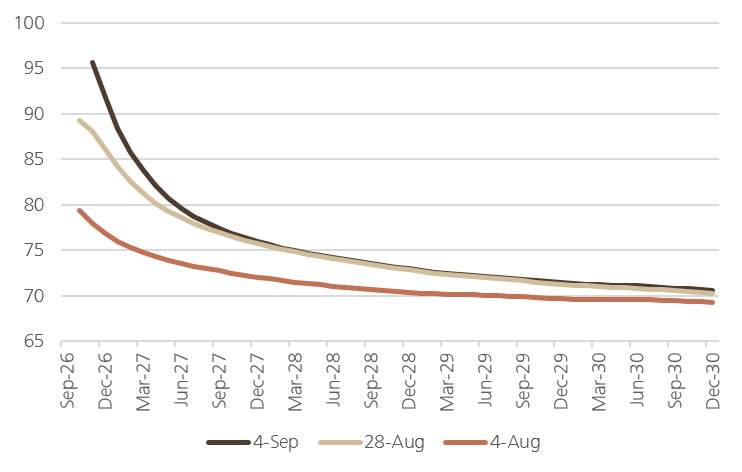
Source: Giovanni Staunovo on Twitter.
With the global oil market fragile and diesel and gas prices rising, the Trump administration may decide to deliver the 39 million barrels not yet awarded from its initial 172 million barrels release announcement from March.
The decision to deliver more barrels has benefits and costs. A rebound in Chinese import demand, a worsening of the supply conditions in the Red and Black Seas, or some unpredictable occurrence could tip the market back towards the highs experienced at the beginning of the Hormuz crisis when dated Brent exceeded $140. This could cause real pain to the economy and may warrant SPR deliveries.
But releasing has costs. SPR deliveries may only offer marginal price relief — at its peak, DOE has delivered 1.4 million barrels per day, which could easily be dwarfed if China returned to its pre-war import levels, for example. Furthermore, if current prices are driven primarily by refining utilization slowing, crude supply may do little to impact prices at the pump. And while the SPR still has more room to deliver crude to the market, doing so limits supply available for future shocks.
There is also the competing priority of refilling the reserve. DOE is currently using the “exchange” mechanism under which it loans barrels to the market but recipients commit to returning them, with a premium, in the future.
If the President determines that further deliveries are warranted, the administration should consider a different mechanism for the next tranche of deliveries. Instead of another exchange, DOE should sell the barrels through the emergency drawdown mechanism and simultaneously contract to buy the same quantity back farther out on the futures curve, where prices are currently lower. The difference between the sale price and the cost of replacement barrels—after accounting for transaction and delivery costs—could then be directed toward the backlog of repairs and upgrades to the SPR’s infrastructure. In short, President Trump should trade the SPR to save the SPR.
After the Iran war began, the administration announced that it would deliver a total of 172 million barrels as part of a globally coordinated 400 million barrel IEA release. To date, the Department of Energy (DOE) has completed delivery of nearly 133 million barrels of crude oil from the Strategic Petroleum Reserve (SPR), the total amount awarded since the conflict with Iran began. That leaves 39 million barrels that could be released to complete the initial obligation.
The rate of release has fluctuated between 300,000 and 1.4 million barrels per day — reflecting logistical realities but also diminishing demand for barrels as the supply picture normalized.[1]
While SPR deliveries have been described in the media as “releases,” DOE is actually conducting a form of acquisition, specifically, exchanges, whereby it delivers to recipients who commit to return those barrels plus a premium to the SPR. In this case, the premium is approximately twenty percent. Once refills are completed, this mechanism will yield DOE approximately 25-30 million additional barrels.[2]
The principal upside of the exchange authority is that DOE can take advantage of backwardation and fill the SPR to a higher level without requiring additional appropriations. Instead of selling oil and receiving cash to be placed in the SPR’s account, DOE is profiting in barrels.[3] Had DOE used the traditional drawdown approach for such a large release, the revenues could have created an attractive source of offsets for unrelated congressional spending.[4] Using the exchange has maximized the probability that the SPR will eventually be refilled.
Additionally, by immediately contracting for returned barrels for delivery down the curve, DOE is establishing forward demand that could improve the investment picture for U.S. oil producers. In 2022, Employ America proposed the exchange approach following the Russian invasion of Ukraine for this reason.
Solicitations have been conducted in regular order and the SPR could eventually be refilled above the pre-Hormuz level of 415 million barrels. In a narrow evaluation of the SPR, DOE has performed competently and the exchange mechanism has worked well.
But maximizing the level of inventory is not the only SPR policy priority. The SPR’s infrastructure requires considerable upgrades and repairs to be fit-for-purpose for a modern economy. There are hundreds of millions of dollars of repairs in the backlog, not to mention previously proposed upgrades that have since been descoped for resource constraints. The SPR’s drawdown capabilities are nowhere near the theoretical maximum.
That creates a choice for future deliveries: another exchange would perhaps yield an additional five to ten million barrels. Alternatively, a sale followed closely with forward repurchases could restore the released barrels but improve its long-term health and viability. The tradeoff is whether those infrastructure improvements outweigh the additional barrels.
We believe they do. DOE has already competently executed exchanges and will receive 25 to 30 million additional barrels— it deserves credit for that—but repairs and modernization could dramatically improve the SPR for the long term.
If the administration decides to deliver more barrels to the market, a release-then-purchase approach could yield a profit available for the SPR’s physical infrastructure, improving our long-term security. The profit from such a trade could cover a substantial portion of the backlog of repairs and upgrades, including repairs to increase drawdown rates or the $230 million backlog for the Life Extension II program, the ten-year infrastructure upgrade DOE has been conducting since 2016.
Of course, DOE (or Congress) could simply decide to sell future barrels to pay for improvements. “Mandated sales” are how Congress funded improvements and upgrades in the past (some of which are still on the books). Mandated sales have a number of drawbacks. They are not timed to the market, so DOE may end up selling into a glut, weakening the environment for U.S. oil producers. Sales also have an impact on the physical infrastructure — over time caverns degrade, which is why they only have a limited number of drawdowns. Mandated sales also depreciate the surface infrastructure. Selling a barrel of oil to pay for infrastructure has limited value if it simultaneously, even marginally, impairs existing caverns. In order to maintain the long-term health of the asset, sales should only be conducted during times of need.
The value of the SPR is that the asset can deliver or purchase oil, not merely that it can store it. Focusing solely on the quantity misses the importance of deliverability. Putting the marginal dollar towards infrastructure improvements increases the national and economic security value of the crude stored in the caverns.
The “trade” would follow three steps:
Deliver up to 39 million barrels to the market via the President’s emergency drawdown authority (a sale);
Contract forward for the same number of barrels at a fixed price; and
With Congressional authorization, put the remaining funds towards funding the backlog of Life Extension II repairs.
The first step is issuing a standard emergency sale under 42 U.S.C. 6241. A sale would require a finding of a “severe energy supply interruption” or that a sale is required under our obligations under the international energy program — both of which are legally straightforward given the crisis in Hormuz and the already agreed to IEA release, under which this sale could occur.
The price at which DOE sells is unlikely to match the spot price of Brent or WTI, even if it sells crude of a similar grade. This is largely a function of the extended solicitation period that opens up buyers and sellers alike to an “open-ended optionality” — they bear the risk that their bid is accepted but market prices deviate in a manner that diminishes their expected return. In the past, this period between solicitation closing and bids being awarded was approximately two weeks.
DOE has delivered barrels to the market at a rate between 300,000 barrels per day and 1.4 million barrels per day, averaging approximately 800,000 per day. Using that average, deliveries could conclude by the end of the year.[5]
The second step is issuing a solicitation to purchase the same number of barrels back. Acquisition procedures under 10 C.F.R. 626 require that DOE use a “price index” to account for fluctuations in the market at delivery. This limits the flexibility of DOE somewhat, but it can use a forward price index during the solicitation and still sign a fixed price contract months, or even years, in advance. Given backwardation in the curve, and the fact that barrels are due to be returned, DOE can acquire far out in the curve, even into 2030,[6] where prices approximate $70.
A solicitation to purchase would have the same leakage issue given the open-ended optionality on the part of DOE—it imposes a number of costs on sellers–costs that would be reflected in offers, partially because it has previously used WTI (the most liquid contract closest in grade to what DOE acquires).
For one, requiring that bids remain open for two weeks means that prospective sellers of crude oil could bear substantial opportunity cost if the spot price rises during the period when offers must remain firmly open for the DOE’s solicitation. The cost of hedging this risk is the cost of buying the corresponding option through financial markets. There are also delivery costs: WTI clears in Cushing, Oklahoma, but delivery to the SPR requires additional cost. There’s also a potential differential premium between the grade of the price trigger and the grade sought–WTI is for light, sweet crude, but more recently, barrels purchased by DOE have tended to be more medium sour, benchmarked by Argus Mars. This means that offers may reflect this differential as well (although Argus Mars, a sour crude benchmark, typically trades below WTI).
Even with this leakage, given that the prices that far out are unlikely to diverge considerably over a two-week period, it wouldn’t be unreasonable for DOE to profit anywhere from $3 to $18 per barrel, opening up anywhere from $120 million to $700 million. This profit could be used for long-term upgrades to the SPR.
The final step is ensuring that the profit from the transaction is available for SPR infrastructure. Generally, SPR funds from sales are available for:
“acquisition, transportation, and injection of petroleum products into the Strategic Petroleum Reserve, for test sales of petroleum products from the Reserve, and for the drawdown, sale, and delivery of petroleum products from the Reserve.”
Under an expansive legal interpretation of the necessary expenses doctrine, infrastructure improvements could fall within purpose if they are necessary to conduct these activities. But relying on that interpretation would introduce avoidable legal uncertainty.
Congress should provide express authorization making the funds remaining after DOE contracts for replacement barrels available for SPR infrastructure improvements, including Life Extension II. Express authorization should be uncontroversial and could be part of a year-end funding package, NDAA, or another legislative vehicle.
Here is a list of potential items to spend it on:
~$650 million — Repairs and updates to restore maximum fill capability.
~$230 million — Operations to clear the maintenance backlog across all four sites as of December 2025.[7]
There are also a number of descoped items from LE2 that might still be worthwhile:
West Hackberry's entire descoped LE2 scope: secondary cavern access wells, brine disposal wells and an additional pump, plus raw water, crude oil, and fire protection updates.
A new degasification plant, descoped from LE2 after parts were already procured. The Vapor Pressure Committee strongly recommended restarting construction immediately, calling degasification critical to future deliverability.
Air-cooled chillers at Bayou Choctaw. DOE has reviewed designs and initiated plans, but the work is not funded.
Big Hill's descoped offsite brine disposal and raw water pipeline, crude oil pipeline, and distribution system upgrades, plus further cuts DOE was still finalizing as of May 2026.
Deferred physical security updates at Bayou Choctaw and Bryan Mound, including camera and fence systems damaged in recent hurricanes.
The exchange mechanism utilized by the Trump administration has been well executed and DOE will receive an additional 25-30 million barrels.
But oil stored in the SPR is not the asset — the value comes from the ability to release and acquire oil, which is also determined by the state of the infrastructure itself. By pursuing a sale-and-repurchase strategy, and devoting profits to the infrastructure, the Trump administration can improve the long-term health of the asset.
Deliveries were front-loaded at the beginning of the conflict. The schedule itself had 30.5 million bbl for July delivery vs. 45 million for August (approximately 33% vs. 49% of its offered volume). The two largest tranches of deliveries, for 22 million and 15 million, were for the Big Hill and Bryan Mound oil reserves and were both dated for August — and the initial solicitation stated that Jones Creek pipeline, which connects to the Bryan Mound site, had pipeline maintenance scheduled in July and would accordingly be closed for deliveries for ten days. If the final awards reflected these delivery mechanics, it is entirely plausible that the July deliveries were expected to be at a lower rate than the prior months (and may pick up in August). ↩︎
Completing these refills will likely take through 2029, depending on when they begin and if they can continue relatively uninterrupted. ↩︎
Contrast this with the 2022 SPR release following Russia’s invasion of Ukraine. The Biden administration released 180 million barrels, earning approximately $17.5bn in revenue, but Congress used $11.5bn of that to pay for cancelling future mandated sales. The net effect was leaving the SPR in roughly the same place it would have been absent intervention but with expected mandated sales. ↩︎
This isn’t theoretical — the SPR account has previously been raided by Congress in spending deals. ↩︎
Market factors notwithstanding, it might be prudent for DOE to complete the deliveries around the end of the year, lest the revenues from the sale be used for anything in a year-end funding deal (unlikely, not nonzero). ↩︎
While DOE staff may be reticent to contract that far out, the agency retains significant incidental and explicit contractual authority to flexibly change these delivery dates should circumstances require it. ↩︎
GAO notes this figure does not reflect the full scope of the reserve's needs. ↩︎