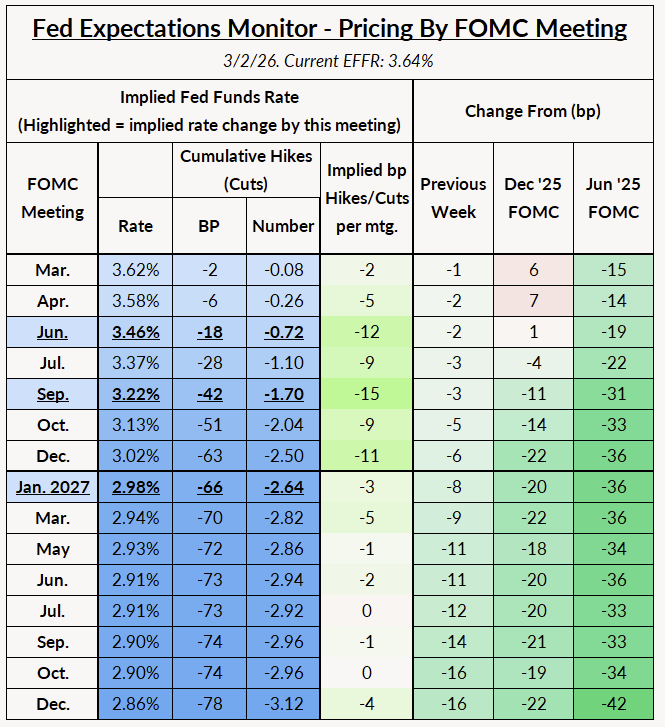
Market views: Market pricing was dovish this week, with pricing almost at 3 cuts for the year.
2026H1: 18 bp of cuts (2 more than last week), with a probable cut in June.
2026H2: 63 bp of cuts (6 more than last week), with a probable cut in September.
2027: Another 15 bp of cuts, with a probable cut in January.
Our views:
Our base case is for no cuts this year. Scant chance of a H1 cut; if any cuts are coming, they'll likely come in Q4.
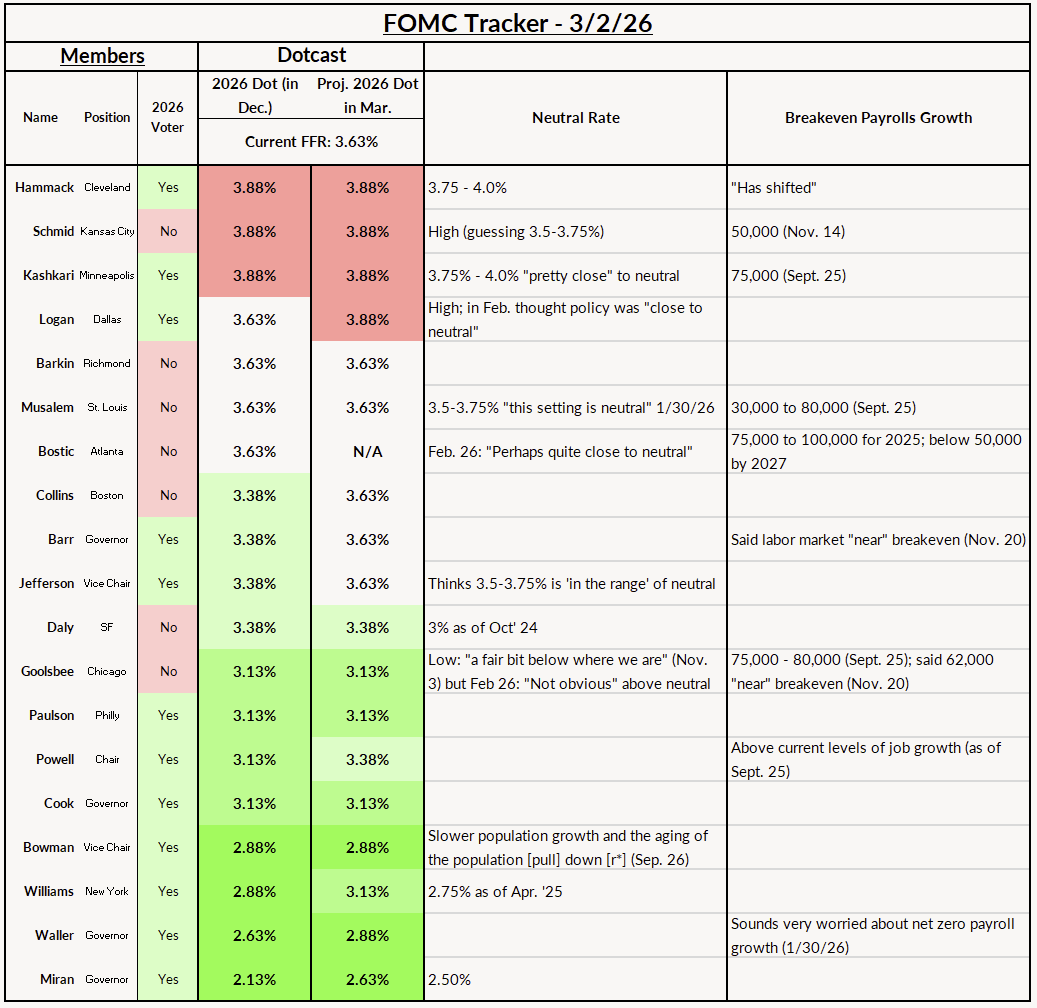
Our base case for March dots for 2026 is 9 for a hike/hold this year, and 9 for a cut [for 18 total; Bostic just retired]. This may move more hawkish as more bad inflation data comes in.
We think the markets are pricing in way too much easing this year. The implications of PPI for PCE (see our corecast for more detail on this) were ugly, with January core PCE inflation looking like it will rise 44 bp. We think it will continue to look ugly for some time, and that Warsh may be unable to get 7 votes for a cut this year, especially if Powell stays on.
One important PPI input to PCE was driven in part by changes to Medicare reimbursement rates, which are likely to stay with us for the remainder of 2026 until they are reset next year.
We see a lot of upside potential for core goods, accommodation, food services, and airfare pricing this year.
Fedspeak this month was mostly a repetition of views from earlier. Importantly, we do not have any Fedspeak after the PPI release on 2/27 which is driving much of our views. However, there still were signs of hawkish moves. Collins says rates are likely to be on hold "for some time" and that we're likely close to neutral. Goolsbee says it's "not obvious" we're even restrictive, which is far closer to the more hawkish wing of the Committee than we've seen him be.
Note: We use a LLM (Claude) to assist in extracting quotes from FOMC appearances. When given the appropriate context, we have found that Claude performs well in this context. We check and edit Claude's work. All of the analysis above this note was written by a human, without LLM assistance.
Opening remarks for "AI and Productivity across the Economy" panel
On AI and unemployment: "job displacement may precede job creation such that the unemployment rate may rise and participation in the labor force may decline as the economy transitions"
On AI and monetary policy tradeoffs: "if AI continues to raise productivity, economic growth could remain strong, even as churn in the labor market leads to an increase in unemployment. In a productivity boom such as this, a rise in unemployment may not indicate increased slack. As such, our normal demand-side monetary policy may not be able to ameliorate an AI-caused unemployment spell without also increasing inflationary pressure"
On the neutral rate: "In anticipation of future productivity gains, we already see soaring AI-related business investment in data centers and chips, despite interest rates broadly being elevated relative to levels over the past 20 years. With investment contributing to strong aggregate demand, it is possible that the current neutral rate is higher than before the pandemic"
"I think it's way too early to sort of sound an all clear that the labor market doesn't need more support from the Federal Reserve. I definitely think the labor market can be supported by the Federal Reserve further" — with four cuts this year
"I really do not think that we have an inflation problem"
"I think that it's quite likely that it will be appropriate to hold the current range for some time"
"After 175 basis points of easing over the past year and a half, we are at mildly restrictive, perhaps quite close to neutral already"
On what she needs to see for cuts: "I am looking for more confidence" that the process of inflation pressures easing resumes; her default outlook "would be that later this year that we might expect to see" inflation pressures cooling off
"I feel that front-loading too many rate cuts is not prudent in that circumstance... Before we cut rates more to stimulate the economy, let's be sure inflation is heading back to 2%"
"People express that prices are one of their most pressing concerns. Let's pay attention"
"We have been burned by assuming transitory inflation in the past and shouldn't make the same mistake again"
"[A 3% inflation rate] is not good enough — and it's not what we promised when the Federal Reserve committed to the 2% target. Stalling out at 3% is not a safe place to be for a myriad of reasons we know all too well"
"With inflation at 3%, it is not obvious that our interest rate policy is even restrictive"
"I remain optimistic that there can be more rate cuts this year. But that hinges on seeing actual progress on inflation that shows we are on a path back to 2%"
On the productivity argument for rate cuts (pushed by Warsh/Miran): "It really isn't the same situation" as Greenspan in the 1990s; "You want to be extremely careful...You can overheat the economy easily"
On labor: "The modest aggregate job numbers can't be far from the true break-even point or else the unemployment rate would have been rising. That's basically the definition of what the break-even point is"
Stubbornly high services inflation isn't tariff driven, emphasizing the need for the Fed to be "vigilant"
Reporters, 2/24 (Bloomberg)
On the Supreme Court tariff ruling: "The more unpredictability you have, the more question marks that the businesses have about policy. The dynamic of low hiring, low firing — which I believe came from business uncertainty — is made even more solidified by adding more uncertainty. That said, it could bring relief to the inflation side"
"I'm a little more concerned about inflation right now because I think the job market is pretty steady. I think growth is pretty steady"
"I'm not hawkish about rates. I'm pretty optimistic that we can get rates down further, multiple cuts in 2026, as long as we see the progress on inflation"
On the tariffs and Supreme Court ruling: "even if the tariffs stay exactly as they were, just in a different form, the inflation impact is supposed to go away"
On the low-hire, low-fire labor market: "That's not really what the beginning of a recession looks like. Low hiring with high layoffs, that's what the beginning of a recession looks like. For both of those to be low is a bit of a weird duck and I think is explained by a lot of we want to wait and see what's going to happen"
On what CEOs want before hiring: "they tend to say is we want to know what the rules of the road are going to be. And right now we don't know what the rules of the road are going to be"
On AI and investment overheating: "you hear a lot of discussion about data center investment demand, using up all the HVAC people, buying up all the electrical equipment, using up computer chips, and in a way making prices higher for the rest of the economy"
"I have some confidence rates can come down several more times this year in 2026. I just don't want to front load it too much before we actually have the evidence that the inflation is headed" back to 2%
"I think we have work to do on the inflation side of things" while "I think we're in a pretty good place for employment"
On the Fed's MBS holdings and mortgage rates: mortgage rates are "probably 75 to 100 basis points lower today than they would otherwise be" due to the current size of Fed mortgage bond holdings
On tariff uncertainty: "Businesses still feel that heightened uncertainty, and that has something to do with why you see such a low hiring rate and why people aren't leaning into investments the way that they might. Hard to know where that's going from here, but I'm not seeing a big pickup on the job growth side"
Sees tariffs as a sort of corporate tax cut because tariffs hit importers and the rebates will be felt mostly along the supply chain. "Maybe some of it will go to the consumer, but a lot more of it will go to the people in the chain"
"cautiously optimistic" that inflation will continue to come down; "I just think you've got a consumer that's exhausted with price increases and just not going to take it anymore. I'm hopeful that inflation is going to come down, and I can see it in some of the behaviors and dynamics"
"I've been reassured by the labor market, also by the demand side, which has stayed relatively healthy, and I think that's the question is whether you need to put more in there on the rate side to help bolster demand"
On AI productivity evidence: "most macro-studies of productivity growth find limited evidence of a significant AI effect... Even firms that say it's useful find little evidence of transformative gains"
On the 1990s parallel: recounts Greenspan's decision to be patient on rate hikes amid the productivity boom, but notes "many things had to happen" before productivity gains materialized; draws explicit parallel to current moment
On monetary policy and AI: "we won't find all the answers in the aggregate data on productivity, the labor market, or inflation. Seeing developments before they fully emerge requires digging deeper... talking to businesses matters"
On baseline outlook: "the economy this year it looks like it's going to grow at or above potential, potentially somewhere around 2%. There are a lot of tailwinds that are going to propel the economy forward. There's fiscal policy tailwinds. We have eased policy by 175 basis points. That's going to help"
On inflation: expects tariff effects on inflation "to fade as the year progresses and then inflation to then resume a trajectory towards our 2% target"
On labor market risks: "The recent job creation has been somewhat narrow, so it's been focused on one or two sectors, so the health care and education sector. And because it's a narrow job creation environment, the job market is vulnerable to an increase in layoffs"
On inflation risks: "there is a possibility that inflation could stay higher than we would all like it to be"
The link has been copied!
Your link has expired. Please request a new one.
Your link has expired. Please request a new one.
Your link has expired. Please request a new one.
Great! You've successfully signed up.
Great! You've successfully signed up.
Welcome back! You've successfully signed in.
Success! You now have access to additional content.